Jogyesa Temple
조계사 · Temple · Seoul
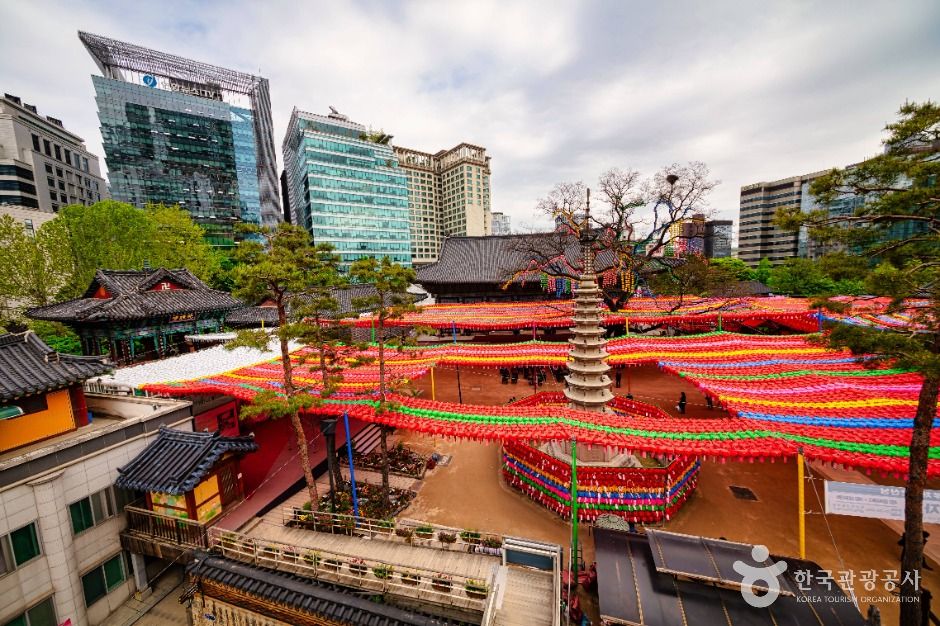
Head temple of the Jogye Order, Korea's largest Buddhist order, right in the city centre. Around Buddha's Birthday the courtyard is covered in lanterns.
Check how busy it is right now →Live crowd levels for Seoul, 14-day forecast elsewhere. No sign-up.
- Admission
- Free
- Opening hours
- Open at any hour
- Closed
- Open daily
- Quietest day
- Tuesday — about 16% fewer foreign visitors than an average dayBusiest: Saturday. Based on Korea Tourism Data Lab foreign-visitor counts for Jongno-gu, Seoul.
- Payment
- Cards accepted
- English
- English signs, some staff
- Nearest subway
- Anguk Station (안국역) · Line 3About 5 minutes on foot
- Fee checked
- 2026-10
Was something different when you went? Tell us — travelers keep these pages right.
When to go
There is no weekly closing day here — you can come any day of the week.
Counting foreign visitors to Jongno-gu, Seoul over twelve weeks, Tuesday is the quietest day you can actually go and Saturday the busiest — a difference of about 30%. These are district-wide figures rather than a headcount at the gate, so treat them as a tendency.
This is an open area rather than a ticketed site, so there are no opening hours to work around. Early morning and late evening are the quietest.
What it costs, and what to bring
Entry is free. Nothing needs to be booked or queued for in advance.
Cards are accepted. Foreign Visa and Mastercard work almost everywhere in Korea, and contactless is normal.
English signage is partial — enough to find your way, not enough to explain what you are looking at. The Korean name above is worth showing to a taxi driver or a passer-by; it works better than pronouncing it.
Getting there
The nearest subway stop is Anguk (안국역) on Line 3, about 5 minutes on foot. Seoul's subway signs and announcements are in English, and a T-money card bought at any convenience store works on every line and bus.
Google Maps · Naver Map · Kakao Map
Google Maps shows public transport in Korea but not walking routes. Naver or Kakao Map gives walking directions.
Eat nearby
Seochon Village is 979 m away. Tongin Market, at the edge of Seochon, is where office workers and locals buy lunch one spoonful at a time.
- Coin lunchbox 엽전 도시락 ₩5,000–10,000
- Oil tteokbokki 기름떡볶이 ₩4,000–6,000
Myeong-dong is 1.1 km away. Street-food carts line the main streets from late afternoon. Easiest place to try many things in one walk.
- Tornado potato 회오리감자 ₩4,000–5,000
- Grilled cheese lobster 치즈랍스터 ₩15,000–20,000
- Egg bread 계란빵 ₩2,000–3,000
Prices are per person and were checked in September 2026. Market stalls are often cash-only even where restaurants take cards.
Near here
- Insadong258 m
- Gwanghwamun Square557 m
- MMCA Seoul (Contemporary Art)573 m
- Cheonggyecheon Stream588 m
- Ikseon-dong Hanok Street606 m